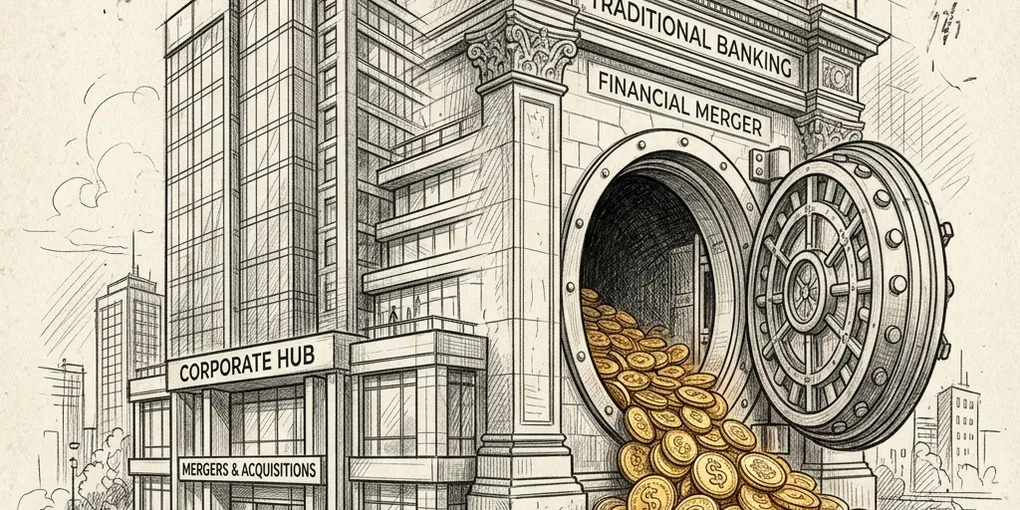
The Financialization of Corporate Business Models
The Illusion of the Pure Product Company
When you walk into a typical coffee shop, you see an exchange of capital for a caffeinated beverage. It is one of the oldest and most fundamental transactions in human history. Yet, beneath the surface of this simple exchange lies a profound transformation in how modern enterprises structure their wealth. The coffee giant you patronize is not merely a purveyor of roasted beans. It is, by all functional definitions, a massive, unregulated financial institution. This subtle shift from selling physical goods to managing complex financial instruments is known as the financialization of the corporate world. It is a sweeping trend that is redefining the very nature of what a business is, blurring the lines between traditional commerce and banking.
To understand the scale of this phenomenon, we must look beyond the glossy storefronts and marketing campaigns. We must examine the balance sheets. A traditional business model involves taking raw materials, adding value through labor or technology, and selling the finished product at a margin. This was the engine of the industrial revolution. Today, however, the most sophisticated companies have realized that the real money is not in the product itself. The product is merely the bait. The true profit engine is the financial ecosystem built around the transaction. By holding customer funds, issuing proprietary currencies, and facilitating loans, everyday corporations are discovering that they can achieve the staggering valuations and capital efficiency typically reserved for Wall Street banks.
The Mechanics of Corporate Float
Consider the mechanics of a closed-loop payment system. When millions of customers load a pre-paid application with twenty dollars, they are effectively granting the corporation an interest-free loan. The company does not need to deliver the coffee immediately. It holds that cash, often billions of dollars in aggregate, as a liability on its balance sheet. In financial terms, this pool of capital is known as float. It is the exact same mechanism that powers massive insurance conglomerates and commercial banks. The corporation can invest this float, earn interest, or use it to fund aggressive expansion without ever needing to approach traditional capital markets or pay exorbitant interest rates to institutional lenders. The customers, driven by the promise of convenience or minor loyalty rewards, willingly fund the empire.
This dynamic creates a profound distortion in how a company operates. When a business realizes it can make more money managing the float than selling the actual product, its priorities inevitably shift. The coffee is no longer the main event. It is a loss leader designed to incentivize deposits. The storefronts become physical branches of a massive shadow bank. The mobile application is a digital wallet. The baristas are, in a very real sense, bank tellers processing deposits. This inversion of the traditional business model is not an isolated occurrence. It is becoming the default strategy for any consumer-facing company with sufficient scale.
The Airline Industry as a Central Bank
This phenomenon extends far beyond the realm of consumer retail. The airline industry provides perhaps the most striking example of corporate financialization in the modern era. To the casual observer, airlines are transportation companies burdened by volatile fuel costs, expensive labor contracts, and the immense capital expenditure of maintaining a fleet of modern aircraft. Historically, the business of moving human beings through the sky has been notoriously unprofitable. Yet, the major airlines are immensely valuable entities. The secret does not lie in their operational efficiency or their route networks. The secret lies in their frequent flyer programs.
These loyalty programs function as sovereign currencies issued by corporate entities. Airlines mint points out of thin air and sell them to credit card companies at a premium. The credit card issuers then use these points to incentivize consumer spending. During periods of economic distress, it has been repeatedly demonstrated that the loyalty program itself is often worth more than the entire physical operation of the airline. The airplanes, the gates, and the staff are essentially loss leaders designed to support the underlying financial machinery. By controlling the supply, the valuation, and the redemption rules of this fiat currency, airlines have transformed themselves into central banks with wings.
The genius of this system is that it completely decouples the airline’s profitability from the physical act of flying. An airline can operate at a significant loss on its passenger operations while simultaneously generating billions of dollars in pure profit by selling miles to its financial partners. The traditional metrics used to evaluate an airline, such as load factor or revenue per available seat mile, become almost irrelevant. The only metric that truly matters is the volume of points created and sold. In this paradigm, the passengers are not the customers. The financial institutions are the customers. The passengers are merely the product being delivered to the financial institutions.
Embedded Finance in the Technology Sector
The tech industry has also aggressively embraced the financialization playbook. Silicon Valley giants, originally built on selling software licenses or hardware, are increasingly embedding financial services into their core offerings. When a technology platform reaches a critical mass of users, the most logical path for expansion is to intermediate the flow of capital between those users. This is the essence of embedded finance. Software companies are rolling out customized credit cards, offering short-term loans, and facilitating peer-to-peer payments. They understand that he who controls the payment rail controls the ecosystem. By capturing the transaction data, these companies gain unprecedented insight into consumer behavior, allowing them to underwrite risk more effectively than traditional, legacy banking institutions.
Consider the evolution of a typical e-commerce platform. Initially, it simply connects buyers and sellers, taking a small commission on each transaction. As the platform grows, it begins to offer payment processing services. Then, it offers working capital loans to its merchants. Finally, it offers consumer credit to its buyers. At each step, the platform inserts itself deeper into the financial lives of its users. It is no longer just a marketplace. It is a comprehensive financial ecosystem. The software is the hook, but the financial services are the primary source of revenue and profit growth.
This strategy is particularly potent because it leverages the massive, proprietary datasets that technology companies have accumulated. A traditional bank must rely on credit scores and income statements to evaluate risk. A technology company, on the other hand, knows exactly what a consumer is buying, when they are buying it, and how they are behaving online. This granular data allows them to offer highly targeted financial products with superior risk profiles. It is an insurmountable competitive advantage that threatens to render traditional banking models obsolete.
The Valuation Arbitrage of Shadow Banking
The allure of this strategy is undeniable. Financial services typically command higher profit margins and more resilient recurring revenue streams than physical product sales. Wall Street analysts aggressively reward companies that can demonstrate software-like margins combined with the capital efficiency of a financial institution. When a non-financial corporation successfully executes this pivot, its valuation multiple expands dramatically. Investors are no longer valuing the company based on how many widgets it can manufacture. They are valuing the company based on the total volume of capital flowing through its proprietary ecosystem.
This valuation arbitrage is the primary driver of corporate financialization. If a retail company is valued at ten times its earnings, but a financial technology company is valued at forty times its earnings, the rational move for the retail company is to rebrand itself as a financial technology company. This is exactly what we are witnessing across multiple industries. Companies are aggressively spinning out their financial divisions or highlighting their embedded finance initiatives in earnings calls. They are desperate to convince the market that they are not merely selling products, but rather operating sophisticated financial networks.
The result is a profound distortion in the capital markets. Trillions of dollars of investment capital are flowing into these hybrid entities, rewarding them for their financial engineering rather than their underlying operational excellence. This creates a dangerous feedback loop. As companies are rewarded for financialization, they have an even greater incentive to prioritize financial services over their core business. The tail begins to wag the dog. The financial machinery becomes the primary focus, while the physical product becomes an afterthought.
The Hidden Vulnerabilities and Systemic Risk
However, this transition is not without profound risks. When a company begins to act like a bank, it inevitably assumes the systemic vulnerabilities of a bank. Traditional financial institutions are highly regulated entities. They are subject to strict capital reserve requirements, regular stress tests, and intense government oversight designed to prevent catastrophic failure. Non-financial corporations operating in the shadow banking sector often face none of these constraints. They operate in a regulatory gray area, innovating rapidly but accumulating hidden layers of systemic risk.
The concept of a bank run is typically associated with panicking depositors lining up outside a traditional financial institution. Yet, the same dynamic can apply to a highly financialized corporation. If consumers suddenly lose faith in a corporate loyalty currency, or if a massive economic shock triggers a wave of defaults in an embedded lending program, the underlying business can collapse with alarming speed. The leverage that drives outsized returns during times of prosperity becomes a fatal liability during a liquidity crisis.
Imagine a scenario where a major retailer experiences a catastrophic data breach or a massive product recall. In a traditional business model, this would lead to a temporary drop in sales and a hit to the company’s reputation. However, in a financialized model, the consequences could be far more severe. Customers might panic and demand immediate refunds for their stored value balances. The company, having invested those funds in long-term assets, might face a severe liquidity crisis. A localized operational issue could quickly escalate into a full-blown financial panic, threatening the solvency of the entire enterprise.
Historical Parallels and Cautionary Tales
History provides sobering examples of the dangers inherent in straying too far from core competencies. In previous decades, massive industrial conglomerates attempted to leverage their sterling credit ratings to build sprawling financial services divisions. For a time, these financial arms generated the vast majority of the parent company’s profits. The market applauded the brilliant synergy. The narrative was that these companies possessed a unique ability to underwrite risk in their specialized industries.
However, when the global credit markets froze, the industrial operations were dragged down by the massive, opaque liabilities hidden within the financial subsidiary. The illusion of stability was shattered, leading to a painful and protracted dismantling of the once-mighty empire. The fundamental flaw was the assumption that operational expertise could be seamlessly translated into financial expertise. The leaders of these industrial giants were brilliant engineers and operators, but they fundamentally misunderstood the complex, intertwined nature of global capital markets. When the tide went out, they were exposed as overleveraged and dangerously naive.
This historical pattern is repeating itself today, albeit in a slightly different form. Modern technology companies and consumer brands believe that their superior data and software capabilities will insulate them from the risks of traditional banking. They assume that their algorithms are flawless and their customer loyalty is absolute. But the laws of finance are immutable. Leverage always amplifies risk, regardless of the technological wrapper. When the next economic downturn arrives, we will discover which of these new corporate banks have built resilient foundations and which are merely swimming naked.
The Democratization of Financial Infrastructure
Despite these historical warnings, the momentum toward corporate financialization appears unstoppable. The underlying technological infrastructure required to launch financial products has been thoroughly democratized. A new generation of infrastructure-as-a-service providers has emerged, allowing any company to easily integrate banking, lending, and card issuance capabilities into their existing applications with a few lines of code. The barrier to entry has plummeted to zero.
In the past, launching a financial product required building entirely new compliance, risk management, and technological infrastructure from scratch. It was a massive undertaking that only the largest corporations could afford. Today, a mid-sized e-commerce brand can launch a customized credit card program in a matter of weeks by partnering with a specialized API provider. This democratization of infrastructure is fueling an explosion of new financial products and services, blurring the lines between industries at an unprecedented rate.
This technological shift suggests a future where every significant company will eventually have a financial component embedded within its business model. The distinction between a retailer, a software provider, and a bank will continue to dissolve. We are moving toward an economy defined by massive, interconnected corporate ecosystems where the primary product is convenience and the underlying currency is data and captive capital. The traditional, standalone bank may eventually become a specialized utility, providing the raw regulatory plumbing while consumer-facing brands own the customer relationship.
The Need for a New Analytical Framework
For the astute investor, this paradigm shift requires a fundamentally new approach to fundamental analysis. It is no longer sufficient to evaluate a company based purely on its operational metrics. Analysts must dissect the balance sheet with the critical eye of a bank examiner. They must understand the velocity of the corporate currency, the quality of the embedded loan portfolio, and the true cost of the accumulated float.
When analyzing a consumer brand, an investor must ask entirely new questions. How much unredeemed value is sitting on the balance sheet? What are the assumptions underlying the valuation of the loyalty program? How sensitive is the embedded lending portfolio to a rise in interest rates? These are complex financial questions that require a deep understanding of banking mechanics. The days of simply projecting revenue growth and applying a generic multiple are over. The modern corporation is a complex financial hybrid, and it must be evaluated as such.
The most successful investments of the next decade will likely be found in companies that master this delicate balancing act. They will be the corporations that seamlessly blend the emotional resonance of a beloved consumer brand with the ruthless, mathematical efficiency of a shadow bank. They will possess the technological sophistication to manage massive pools of capital and the operational discipline to avoid the systemic risks that have brought down their predecessors. Identifying these rare hybrids will be the ultimate challenge for the next generation of investors.
The Enduring Blurring of Boundaries
The evolution of the corporate model from product manufacturer to financial orchestrator is one of the defining economic narratives of our time. It is a testament to the relentless pursuit of capital efficiency and the innovative nature of modern enterprise. As consumers, we are willing participants in this grand experiment, trading our deposits and our data for incremental conveniences and digital rewards.
We enthusiastically load our digital wallets, sign up for co-branded credit cards, and participate in complex loyalty schemes, rarely considering the profound financial implications of these actions. We are the fuel for this massive engine of corporate financialization. The coffee shop is a bank. The airline is a central bank. The software company is a global payment network. The financialization of everything is not a future possibility. It is the current reality, quietly orchestrating the flow of global capital behind the comforting facade of everyday commerce.
This transition challenges our fundamental understanding of economic systems. The textbooks of the past defined companies strictly by the products they produced. A car company made cars. A shoe company made shoes. Today, those definitions are hopelessly outdated. A modern company is a sprawling ecosystem of interconnected services, all designed to capture and monetize customer attention and capital. The physical product is merely the entry point. The real game is played in the hidden layers of financial engineering.
As we navigate this new reality, regulators will increasingly struggle to define and contain the risks of shadow banking. How do you regulate an airline that acts like a central bank? How do you ensure the stability of a massive retail operation that holds billions of dollars in uninsured customer deposits? These are the defining regulatory challenges of the twenty-first century. The line between commerce and finance has been permanently erased, and we are only beginning to comprehend the consequences of this profound and irreversible transformation.