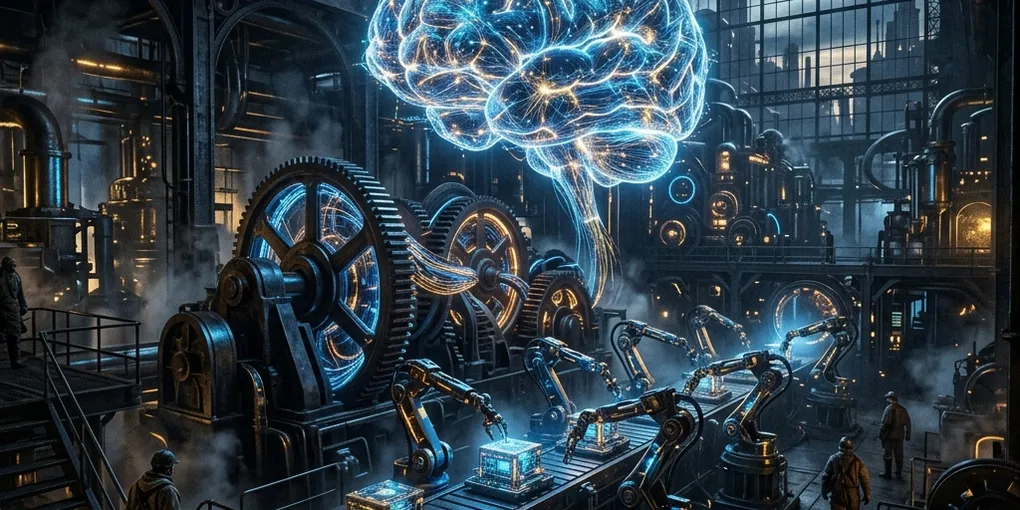
The Industrialization of Intelligence
The year 2026 marks the definitive end of what historians and market analysts have come to call the era of artificial intelligence tourism. For years, the corporate world treated generative models as exotic novelties, curiosities to be explored through pilot programs, experimental chatbots, and isolated productivity hacks. We watched as CEOs demoed impressive language capabilities in boardrooms while the actual organizational structure beneath them remained stubbornly analogue. This was a period of frantic experimentation, a gold rush where the main objective was simply to participate, regardless of whether that participation translated into a fundamental shift in the bottom line. But the novelty has finally evaporated, replaced by a much more sober and formidable reality: the industrialization of intelligence. This is no longer about tools that help us work faster; it is about a wholesale re-architecting of the firm around the concept of automated, autonomous, and industrial-scale cognition.
To understand this transition, one must look back at the original industrial revolution. Before the steam engine, power was artisanal, localized, and inherently limited by the physical capacity of animals or humans. The steam engine did not just make work faster; it standardized power itself, turning it into a reliable, consistent, and scalable resource that could be deployed across an entire factory floor. Today, we are witnessing a similar standardization of intelligence. We are moving from a world where insight was a rare, human-dependent craft into one where “tokens” are the new raw material of industry. In this new paradigm, intelligence is no longer a high-cost variable dependent on localized talent; it has become a base-load utility, a massive, centralized force that can be channeled through the “pipes” of an organization with the same reliability as electricity or high-speed data.
The implications of this shift are profound and, for many, deeply unsettling. The traditional corporate hierarchy, a structure that has served as the bedrock of global business for over a century, was designed specifically to manage the limitations of human communication and localized decision-making. Middle management was the “buffer” that translated high-level strategy into low-level execution, a human mesh network designed to ensure that information flowed from the top down and data flowed from the bottom up. However, in an industrialized intelligence landscape, this mesh network is increasingly redundant. When strategy can be encoded into high-fidelity agentic workflows that execute with millisecond precision, the need for human “translators” begins to dissolve. We are seeing the rise of a new kind of “business physics,” where the friction of management is being replaced by the velocity of automated orchestration.
This systemic rebuilding starts with the concept of the tokenized supply chain.
The Tokenized Engine of the New Economy
In the previous era, a company’s performance was measured by its headcount and the efficiency of its human capital. In 2026, the metrics have shifted toward token throughput and model-to-resource alignment. Forward-thinking firms are no longer asking how many employees they need to run a marketing department; they are asking how many “intelligent agents” can be sustained by their proprietary data pipelines and how those agents can be integrated into a continuous, feedback-driven loop. This is the industrialization of thought itself. Every interaction, every customer support ticket, and every creative brief is now seen as a “unit of intelligence” that can be processed, optimized, and scaled through an automated infrastructure.
Let us consider the “Tokenized P&L,” or Profit and Loss statement, which is rapidly becoming the standard for modern enterprise accounting. In the old world, labor was a variable cost that scaled with volume. In the new world, intelligence is a fixed-asset infrastructure that provides a marginal cost of zero for every additional task it performs. This flips the traditional economic model of a service-oriented firm on its head. If a law firm can automate 90 percent of its document review using an industrialized cognitive pipeline, its revenue is no longer tied to “billable hours” but to its “compute-to-value” ratio. This creates an immense amount of leverage for those who own the infrastructure, while simultaneously hollowing out the business models of those who continue to rely on human labor for routine cognitive tasks.
However, the path to this industrialized state is not merely a matter of buying more compute or subscribing to better models.
Re-architecting the Firm for Industrial Insight
The true bottleneck for most organizations in 2026 is their own internal architecture. Most businesses are still organized like 20th-century bureaucracies, with siloed departments, antiquated data schemas, and decision-making processes that require days or weeks of manual review. To move toward an industrialized model, these firms must undergo a process of “radical simplification.” This involves stripping away the layers of administrative overhead and replacing them with integrated systems of record that can be read and acted upon by autonomous agents. The “Architect” has replaced the “V-P of Operations” as the most critical role in the C-suite. Their job is not to manage people, but to design the pipelines through which intelligence flows, ensuring that every part of the organization is connected to the central cognitive engine.
The role of the Architect is essentially that of a cognitive plumber and a digital cartographer. They must map out the “intellectual topography” of their company, identifying exactly where knowledge is generated, where it is consumed, and where it is currently lost in the “digital sprawl” of legacy spreadsheets and unrecorded conversations. By building a unified data architecture, they allow the company’s autonomous agents to “see” the entire business at once. This creates what some analysts call a “Single Source of Truth,” but on a dynamic and intelligent scale. Every inventory update, every customer feedback loop, and every market shift is immediately ingested by the system, allowing for a level of operational responsiveness that was previously impossible.
As this restructuring proceeds, the nature of the competitive moat is also evolving.
The Competitive Moat: Proprietary Data and the Feedback Flywheel
In the “digital” era, the moat was often based on network effects or platform dominance. In the “intelligence” era, the moat is defined by the quality, exclusivity, and velocity of a company’s data-feedback loop. If everyone has access to the same frontier models, then the model itself is a commodity. The real value lies in the proprietary “dark data” that lives within a firm’s specific workflows: the nuances of its manufacturing processes, the specific preferences of its long-term clients, and the thousands of micro-adjustments made by its expert supervisors over decades. The industrialization of intelligence allows a firm to “ingest” this human expertise and turn it into a repeatable, scalable asset. A company that failed to digitize its expertise in the early 2020s now finds itself at a permanent disadvantage, unable to feed the hungry engines of its autonomous agents.
This proprietary data is the fuel for what we now call the “Flywheel of Feedback.” In this model, every action taken by an agentic system is monitored for its outcome, and those outcomes are immediately fed back into the system to refine the next action. This allows an industrialized intelligence system to “learn” at a rate that is orders of magnitude faster than a human organization. While a human team might conduct a “post-mortem” on a project once every quarter, an industrialized firm is conducting millions of micro-adjustments every single hour. The result is a level of optimization that feels almost uncanny. It is a process of “automated evolution” where the firm is constantly shedding its inefficiencies and doubling down on what works, all without the need for a single “all-hands” meeting or a committee-driven strategic review.
Furthermore, we are seeing a shift in the way capital is allocated within these firms. In the past, “SG&A” (Selling, General, and Administrative) expenses were often seen as a necessary evil, the overhead required to keep the lights on and the people moving. In the hybridized corporation of 2026, SG&A is being transformed into “R&D” and “Infrastructure” spending. When you automate a sales process using a swarm of autonomous agents, you are not just “paying for a service”; you are building a permanent digital asset that grows more valuable with every interaction. This shift from “opex” to “capex-like” spending on intelligence is confusing traditional accounting departments, but it represents the true financial reality of the new economy. The most valuable companies are no longer those with the largest human footprints, but those with the most efficient “intelligence density.”
This brings us to the rise of governance as a strategic infrastructure.
Governance as the Foundation of Scale
In the early days of AI, governance was often seen as a chore, a set of hurdles that slowed down innovation. But as intelligence is industrialized, governance is becoming the very framework that makes scale possible. You cannot run a million-agent corporation if you cannot guarantee that every agent is operating within strictly defined ethical, legal, and operational boundaries. In 2026, the leading firms treat governance not as a compliance checklist, but as a “security-by-design” requirement for their entire cognitive stack. They are building “governance-native” architectures where every decision made by an automated system is logged, auditable, and subject to instantaneous programmatic correction. This level of oversight would be impossible with a purely human workforce, but it is a fundamental requirement for the industrial-scale deployment of intelligence.
We must also consider the geopolitics of industrialized intelligence. Just as nations have historically competed for access to coal, oil, and semiconductors, the global battleground has now shifted toward the control of “intelligence infrastructure.” Nations that possess the combination of vast compute clusters, advanced energy grids, and high-quality proprietary data sets are the new superpowers of the 21st century. This has led to the rise of “sovereign intelligence,” where governments are building their own nationwide cognitive grids to power their industries and protect their citizens. For the individual business, this means that their choice of infrastructure provider is no longer just a technical decision, but a geopolitical one. They must navigate a complex web of regulations, data residency requirements, and international alliances to ensure that their industrialized intelligence pipelines remain secure and operational.
The societal implications of this shift are equally vast.
The Rise of the Orchestrator and the Million-Agent Corporation
We are moving toward what some economists call the “Million-Agent Corporation,” a company that can generate billions in revenue with only a handful of human “Orchestrators” at the helm. These Orchestrators are the new elite class of the business world: individuals who possess both deep domain expertise and the technical ability to manage massive, distributed swarms of autonomous intelligence. Their role is not to do the work themselves, but to maintain the “vision” and ensure that the various agentic swarms remain aligned with the company’s long-term objectives. For the rest of the workforce, the transition is more challenging. The types of “routine cognitive” work that once supported the middle class are being rapidly industrialized, and the pressure to move “up-market” into purely creative or highly specialized empathetic roles is intense.
This new class of Orchestrators must develop a unique set of skills that we are only beginning to define. They must be part philosopher, part engineer, and part conductor. They need to understand the “probabilistic” nature of the intelligence they are managing, recognizing that an autonomous agent is not a deterministic robot but a highly complex cognitive system that can, at times, behave in unexpected ways. The Orchestrator’s job is to design the “constraints” and “incentives” that keep these agents on track, much like a conductor ensures that an orchestra follows the same sheet music while still allowing for individual artistic expression. It is a role that requires a high level of “intellectual humility,” as one must accept that the collective intelligence of the swarm will often exceed the individual intelligence of the manager.
Despite the fears of total automation, the industrialization of intelligence is actually revealing the unique and irreplaceable value of human judgment.
The Synthesis of Human Discernment and Automated Execution
While an agentic swarm can process data, execute trades, and optimize supply chains with superhuman efficiency, it cannot “want” anything. It lacks the biological imperative, the moral compass, and the ability to define what truly “matters” in a human context. The most successful businesses of 2026 are those that have found the perfect synthesis between industrial-scale intelligence and artisanal human oversight. They use the automated machinery of intelligence to handle the “how” of business, while leaving the “why” to the humans. This partnership is the defining characteristic of the modern corporate machine.
This partnership is perhaps most visible in the realm of high-stakes creative endeavor and strategic innovation. While a model can generate thousands of marketing slogans or product designs in a matter of seconds, it still requires a human to recognize which of those designs will resonate with the deep, unspoken desires of a customer base. The “Human in the Loop” has evolved into the “Human on the Edge,” where they act as the ultimate filter and arbitrator of value. This requires a level of “taste” and “discernment” that cannot yet be industrialized. The firms that thrive in 2026 are those that have cultivated this human discernment, treating it as the “precious metal” that gives their industrialized cognitive output its true value.
As we look toward the end of this decade, the industrialization of intelligence will likely follow the same trajectory as previous technological revolutions. What was once seen as a disruptive and terrifying force will eventually become invisible, a background utility that we take for granted. We will stop talking about “AI companies” and simply talk about “companies,” because the integration of intelligence into every facet of business will be as fundamental as the integration of the internet or the electrical grid. The winners of this transition will be those who leaned into the rebuilding phase early, who recognized that the era of tourism was a mere prelude to a much more profound industrial transformation. They are the ones who stopped playing with chatbots and started building the pipelines that will power the next century of global industry.
This integration will also lead to a new form of “digital metabolism.”
The New Corporate Metabolism and the Democratization of Scale
A company’s metabolism is the speed at which it can process information, make a decision, and take action. In the artisanal era, this metabolism was limited by the speed of human meetings and the constraints of physical hierarchies. In the industrialized era, a company’s metabolism is limited only by the latency of its computer networks and the efficiency of its cognitive architecture. This allows for a level of “real-time business” that has never been seen before. A company can adjust its global prices, its supply chain routes, and its marketing messaging in response to a geopolitical event in the same time it takes a human manager to read the first headline. This increased metabolism is a massive competitive advantage, allowing the industrialized firm to “live” and “respond” at a speed that is simply impossible for its analogue rivals.
The process of rebuilding is not without its casualties. The history of business is littered with the carcasses of once-dominant firms that were too slow to adapt to a changing technological landscape. In 2026, the “dead zones” are increasingly visible: companies that are bogged down by administrative debt, whose data is locked in inaccessible silos, and whose leadership remains committed to the org charts of the past. These firms are finding it harder to compete for capital, talent, and customers, as they are simply out-maneuvered by the velocity and precision of their industrialized competitors. For these laggards, the message is clear: the window of opportunity for “pilot programs” has closed. The era of industrial intelligence is here, and it demands nothing less than a complete reimagining of what a corporation is and what it is meant to achieve.
We must also acknowledge the “Cognitive Burnout” that can occur in organizations that fail to manage this transition properly. Industrialization is a high-pressure process, and if it is applied haphazardly, it can lead to a culture of frantic automation and a loss of human connection. The most forward-thinking firms are those that recognize this risk and are actively building “restorative” architectures that prioritize human well-being alongside industrial efficiency. They are creating environments where the automated systems handle the “noise,” allowing the humans to focus on the “signal,” thereby reducing the cognitive load on their workforce and fostering a more sustainable and fulfilling work culture.
In this new world, the concept of “scale” has also been redefined. Previously, scaling a business meant hiring more people, opening more offices, and dealing with the exponentially increasing complexity of human management. Today, scale is a function of “compute-to-intelligence” ratios. A startup of five people can, with the right architecture, deploy an agentic workforce that rivals a Fortune 500 company in its operational reach. This “democratization of scale” is creating a new wave of disruptive competitors, small but highly industrialized firms that are attacking the legacy margins of established giants. The corporate giants, in turn, are forced to cannibalize their own legacy structures in a desperate bid to match the efficiency of these agile newcomers.
This democratization also means that the “barrier to entry” for many industries is shifting from “capital” to “architectural excellence.” If a small team can design a superior cognitive pipeline, they can theoretically compete with any incumbent, regardless of their size. This is leading to a renaissance in entrepreneurship, where the most valuable asset is not a factory or a global brand, but a better way to organize intelligence. These “Neo-Industrialists” are building a new generation of firms that are lean, highly automated, and incredibly powerful, creating a more dynamic and competitive global economy.
The reflective path forward requires a new kind of leadership.
Leadership in the Age of Automated Insight
It is no longer enough to be a charismatic manager of people or a savvy navigator of capital markets. The business leaders of 2026 must also be “systems thinkers,” individuals who can see the organization as a holistic, integrated cognitive machine. They must understand the technical foundations of the models they deploy, the ethical implications of the autonomous decisions being made in their name, and the strategic importance of the data they cultivate. This is a demanding and intellectually rigorous path, but it is the only one that leads to sustainable success in an age of automated insight.
These leaders must also champion what we might call “Ecological Intelligence.” Just as a biological ecosystem depends on the balance between different species and resources, an industrialized cognitive ecosystem depends on the balance between models, data, and human oversight. A leader’s job is to ensure that this ecosystem remains healthy, diverse, and resilient, avoiding the “monocultures” of thought that can lead to catastrophic failures. They must foster a culture of “epistemic diversity,” where different models and human perspectives are encouraged to challenge one another, creating a more robust and reliable corporate machine.
Ultimately, the industrialization of intelligence is a story about human potential.
The Reflective Path Forward: From Tourism to Industry
By offloading the routine, the repetitive, and the mundane to the industrial machinery of cognition, we are freeing up human beings to focus on the things that truly matter: creativity, empathy, strategic vision, and the pursuit of meaning. The “Rebuilt Corporate Machine” is not a cold, unfeeling apparatus; it is an incredible tool that, when used wisely, can amplify our collective intelligence and help us solve some of the most complex challenges facing our world. We are just beginning to understand the true power of this new industrial era, and the decisions we make today will ripple through the architecture of global commerce for generations to come. The era of tourism is over; the era of industry has begun.
This new era also offers a unique opportunity to address the “Inefficiency of Information” that has plagued human civilization for millennia. Much of our history is a record of wasted potential, of ideas that were forgotten, insights that were ignored, and resources that were misallocated because we simply did not have the cognitive capacity to manage them. Industrialized intelligence allows us to capture and utilize this “lost information,” creating a world that is not only more efficient but also more equitable and sustainable. We can now design systems that can balance the needs of millions of individuals in real-time, optimizing everything from urban traffic to global resource distribution. This is the promise of the industrialization of intelligence: a future where the power of thought is no longer a limited and precious resource, but a common utility that can be used to build a better world for everyone.
The transition from artisanal insight to industrial intelligence is perhaps the most significant shift in the history of business. It is a process that is both terrifying and exhilarating, demanding we rethink everything we thought we knew about the nature of work, the structure of the firm, and the meaning of success. But for those who are willing to embrace the challenge, who are willing to tear down the old structures and build the new ones, the rewards are immense. We are standing at the threshold of a new industrial age, an age defined by the power of the automated mind and the vision of the human heart. The corporate machine is being rebuilt, and the blueprints are being written in the language of intelligence. The choice is yours: will you be an architect of this new era, or a relic of the old one?