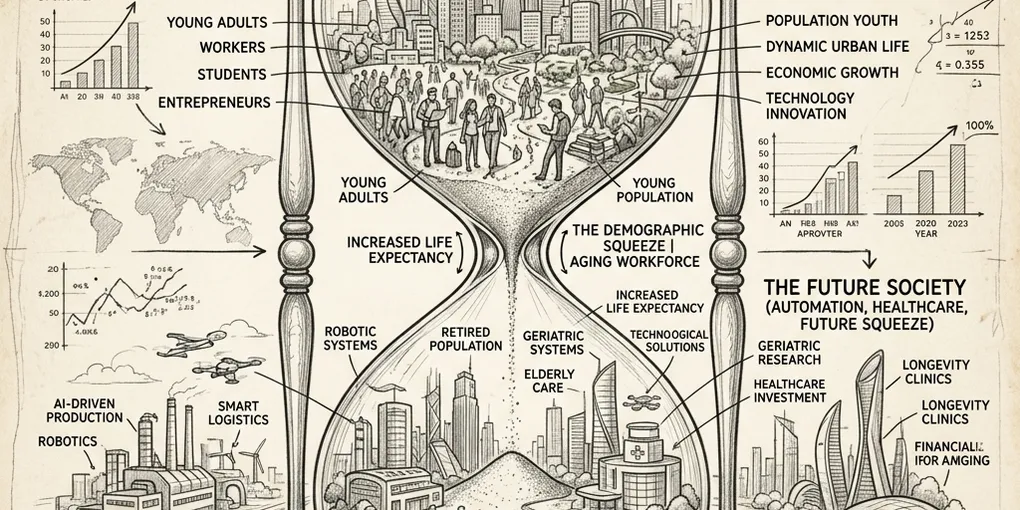
The Great Demographic Shift: Investing in an Aging World
Imagine a world where the fundamental engine of economic growth begins to run in reverse. For the entirety of modern financial history, investors have relied on a simple and almost invisible tailwind. More people meant more consumption, more workers, and more innovation. It was an era of perpetual expansion driven by biology as much as by technology. Today, we are standing at the precipice of a structural inversion that will redefine the allocation of capital for the next fifty years. The global population is aging at a rate unprecedented in human history, shifting the center of economic gravity away from youthful expansion and toward the complex management of longevity. This is not a distant theoretical possibility. It is an active rewiring of global capital markets, altering everything from the cost of labor to the valuation of real estate. Uncovering the hidden mechanics of this demographic transition is essential for any investor seeking to navigate the coming decades.
To comprehend the scale of this shift, one must look at the foundation of macroeconomic models. Traditionally, gross domestic product growth is a function of labor force growth combined with productivity growth. When the labor force shrinks, the entire burden of economic expansion falls squarely on the shoulders of productivity. Across the developed world, and increasingly in emerging markets, birth rates have collapsed below the replacement level of two point one children per woman. Nations that once exported surplus labor are now hoarding it. As a result, the global labor pool is contracting, turning a multi-decade era of labor abundance into an era of chronic labor scarcity. This structural deficit forces a profound realignment in corporate strategy. Companies can no longer rely on throwing cheap human capital at complex problems. They are compelled to invest heavily in fixed capital, automation, and systemic efficiencies just to maintain their current output. This dynamic creates a powerful undercurrent in the investment landscape, rewarding enterprises that facilitate productivity and punishing those reliant on endless supplies of low-cost workers.
The implications for the labor market extend far beyond simple wage inflation. As the proportion of working-age individuals declines relative to retirees, the dependency ratio skyrockets. This ratio, a critical metric for sovereign wealth and national stability, measures the number of dependents against the number of active producers. A rising dependency ratio strains public finances, forcing governments to allocate larger portions of their budgets to pensions and healthcare. The cascading effect on capital markets is profound. Sovereign debt issuances must expand to cover the shortfall, potentially crowding out private investment and establishing a higher floor for interest rates. Investors must therefore recalibrate their expectations for fixed income, recognizing that the era of structurally depressed yields may be permanently behind us. In this environment, capital flows naturally toward assets that offer genuine scarcity value and pricing power. The companies that thrive will be those capable of passing along higher input costs without destroying demand, a characteristic often found in businesses with deep moats and essential services.
The healthcare industrial complex stands at the very center of this demographic transformation. It is arguably the most direct beneficiary of an aging population, yet the investment thesis requires significant nuance. It is not enough to simply buy pharmaceutical companies or hospital operators. The true value migration is occurring in the spaces where healthcare intersects with technology and logistics. As chronic diseases become more prevalent with age, the burden on traditional healthcare infrastructure becomes unsustainable. This constraint necessitates a shift from centralized, acute care models toward decentralized, preventative, and continuous monitoring systems. Innovations in biosensors, telemedicine infrastructure, and predictive analytics are no longer speculative ventures but critical necessities. The companies building the architecture for this decentralized care model are poised to capture immense value. They are solving the central economic problem of modern healthcare, which is delivering higher quality outcomes at a structurally lower cost per patient. Analysts suggest that the total addressable market for these efficiency-driving technologies is expanding exponentially, creating opportunities that rival the software revolution of the early two thousands.
The physical footprint of our cities and communities must also adapt to this new demographic reality. Real estate, long considered a stable cornerstone of institutional portfolios, is undergoing a quiet but radical repurposing. The suburban expansion model built for young families is gradually giving way to the complex requirements of an aging demographic. There is a surging demand for specialized residential environments that offer a continuum of care, integrating medical services, accessibility, and community engagement. This is not merely the construction of traditional nursing homes. It represents the development of entirely new asset classes within the real estate sector. Properties that can seamlessly blend high-end residential living with state-of-the-art medical logistics are commanding premium valuations. Concurrently, the chronic labor shortage is reshaping commercial real estate. As retail and logistics companies turn to robotics to fulfill orders, the specifications for industrial spaces are changing. Warehouses require heavier power loads, specialized flooring, and hyper-efficient spatial designs to accommodate automated systems. Investors who anticipate these shifting spatial requirements and allocate capital toward specialized, future-proofed real estate assets are positioning themselves ahead of a massive demographic wave.
The automation dividend is perhaps the most critical variable in mitigating the economic drag of an aging workforce. With fewer human hands available to perform essential tasks, capital expenditure in robotics, artificial intelligence, and advanced manufacturing becomes non-discretionary. We are witnessing a profound industrialization of intelligence, where cognitive and physical tasks are systematically unbundled and automated. This creates a compounding cycle of investment in the foundational layers of technology infrastructure. Semiconductor foundries, data centers, and advanced materials manufacturers form the bedrock of this new productivity engine. The investment opportunity lies not just in the creators of the software algorithms, but in the physical manifestations of automation. Companies that design the highly specialized components for industrial robotics, from precision actuators to sophisticated vision systems, are experiencing a structural re-rating. Their products are the vital tools required to offset the demographic deficit. Historical trends indicate that when economies face severe labor constraints, they typically undergo periods of accelerated technological adoption. This historical precedent suggests that we are at the early stages of a massive capital deployment cycle aimed squarely at boosting output per worker.
The intersection of aging demographics and financial markets also creates fascinating dynamics in wealth management and asset allocation. As the largest and wealthiest generation in history transitions into retirement, their investment objectives shift from capital appreciation to capital preservation and income generation. This massive pool of capital is searching for yield in a world where traditional fixed income may no longer provide adequate returns. This dynamic is fueling the rise of alternative investment vehicles, particularly private credit and infrastructure assets. These asset classes offer the potential for stable, long-term cash flows that match the liability profiles of institutional pension funds and individual retirees alike. The structural demand for yield is reshaping the architecture of the financial industry, shifting power away from traditional commercial banks and toward nimble, specialized asset managers capable of structuring complex private market transactions. The democratization of access to these private markets is another fascinating secondary effect, as technology platforms emerge to connect individual investors with institutional-grade assets.
The global nature of this demographic shift means that investors must think beyond their domestic borders. The rate of aging is not uniform across the globe. Certain emerging markets still possess favorable demographic profiles, offering potential growth vectors that contrast sharply with the developed world. However, the simplistic narrative of investing in emerging markets solely for their young populations is increasingly flawed. Capital must be deployed selectively, focusing on nations that possess the institutional frameworks and infrastructure necessary to harness their demographic dividends. Conversely, some of the most rapidly aging nations, such as Japan and several European countries, are paradoxically becoming laboratories for the automation and healthcare solutions of the future. By observing the technological adoption curves in these early-adopter nations, investors can gain a predictive edge regarding the trends that will inevitably sweep the rest of the developed world. The global capital allocator must act as a demographic arbitrageur, balancing the high-growth potential of emerging labor forces against the deep technological capabilities of advanced, aging economies.
As we synthesize these disparate threads, a cohesive investment philosophy for the coming era begins to emerge. The next few decades will not be defined by the easy beta of broad market indices fueled by endless demographic expansion. Instead, returns will be driven by structural alpha, generated by companies that successfully navigate the constraints of an aging world. This requires a rigorous focus on businesses with immense pricing power, as they are insulated from the inevitable cost pressures of a shrinking labor pool. It demands a deep understanding of the second and third-order effects of the healthcare transition, moving beyond simple therapeutics to the infrastructure of care delivery. It necessitates a re-evaluation of real estate, prioritizing specialized assets over generic commercial spaces. Most importantly, it requires a profound appreciation for the companies driving the productivity revolution, as their technologies are the only viable solution to the fundamental economic arithmetic of a declining workforce.
Ultimately, the great demographic shift is not a crisis to be feared, but a reality to be managed. It represents the closing of one economic chapter and the opening of another. The investors who will thrive in this new environment are those who discard outdated models predicated on perpetual demographic growth. They will embrace the complexities of scarcity, allocating capital toward the innovators and infrastructure builders who are forging the future. The transition will be volatile, marked by shifts in geopolitical power, changes in monetary policy, and the relentless march of technological disruption. Yet beneath this surface volatility lies a deeply predictable demographic current. By aligning portfolios with this unstoppable force, investors can secure generational wealth while simultaneously funding the solutions required to sustain global prosperity in an aging world. The future belongs to those who recognize that the most profound transformations often occur slowly, silently, and inevitably.
To fully grasp the magnitude of this transition, it is helpful to examine historical precedents, although true analogues are scarce. Historical events that triggered massive population declines, such as widespread pandemics or global conflicts, often resulted in severe labor shortages followed by dramatic shifts in capital allocation and technological innovation. However, those historical shocks were abrupt and often destructive to capital as well as human life. The current demographic shift is unique because it is gradual, predictable, and occurring alongside an explosion in technological capability. This allows markets to anticipate the constraints and proactively allocate capital to solve them. For example, the post-war baby boom provided a massive tailwind for consumer discretionary spending, housing, and automotive industries. Today, we are witnessing the mirror image of that boom. The capital that previously flowed into building suburban infrastructure for young families is now seeking opportunities in the “longevity economy.” This encompasses not only healthcare but also leisure, continuing education, and specialized financial services designed to support individuals who may live two or three decades post-retirement.
The longevity economy represents a fundamental restructuring of consumer demand. Retirees of the future will not simply be passive consumers of medical care. They represent a massive cohort of individuals with significant accumulated wealth, seeking ways to enhance their quality of life, maintain their independence, and manage their complex financial needs over extended time horizons. This shifts the focus toward companies that can provide integrated lifestyle solutions. We are seeing the emergence of sophisticated aging-in-place technologies, ranging from smart home modifications to mobility assistance devices and robotic companions. Equally important, the financial services industry must innovate rapidly to address the decumulation phase of wealth. Traditional annuity products are often too rigid, prompting the development of flexible payout structures, longevity insurance, and dynamic asset allocation models that adapt to changing health profiles and market conditions. Investors who recognize that the aging demographic is a diverse group with varied needs and immense purchasing power will uncover opportunities far beyond traditional healthcare.
Geopolitically, the uneven distribution of this demographic aging will reshape global power dynamics and international capital flows. The developed world is currently leading this transition, but the most dramatic shifts are occurring in specific emerging markets. China, for instance, is experiencing an unprecedented demographic acceleration, shifting from a labor-abundant manufacturing powerhouse to a rapidly aging society in a compressed timeframe. This transition forces China to pivot aggressively toward high-value manufacturing, robotics, and artificial intelligence to offset its shrinking workforce. For global investors, this signals a major realignment in supply chains. The era of relying on a single dominant manufacturing hub with endless cheap labor is over. Supply chains are becoming regionalized, highly automated, and distributed across nations with more balanced demographic profiles or advanced manufacturing capabilities. This “friend-shoring” or near-shoring trend is driving massive capital expenditures in industrial infrastructure across regions like North America and Southeast Asia, creating a multi-decade investment megatrend in the physical assets that support these newly configured supply chains.
The implications for sovereign debt markets are equally profound and require careful navigation. As national populations age, the ratio of taxpayers to beneficiaries declines, putting immense pressure on fiscal budgets. Governments face the difficult choice of reducing benefits, increasing taxes, or issuing more debt. Given the political difficulty of the first two options, the most likely outcome is sustained high levels of sovereign borrowing. This dynamic introduces a complex tension into fixed income markets. On one hand, aging populations typically demand safe, yield-generating assets, which should support demand for government bonds. On the other hand, the sheer volume of debt issuance required to fund unfunded pension and healthcare liabilities could overwhelm this demand, leading to higher long-term interest rates and potential currency debasement. Investors must therefore scrutinize sovereign balance sheets with the same rigor applied to corporate credit. The concept of a “risk-free rate” is evolving, and capital will increasingly flow toward jurisdictions with sustainable demographic trajectories or the technological capacity to outgrow their demographic constraints. In this environment, hard assets, infrastructure, and companies with pricing power become essential tools for wealth preservation against the backdrop of fiscal expansion.
Ultimately, the demographic shift is the supreme macroeconomic variable of our time. It is the hidden force shaping everything from the cost of capital to the structure of global trade. The transition will inevitably create winners and losers. Traditional business models that rely on endless market expansion and cheap labor will face secular decline. Conversely, businesses that provide solutions to the challenges of scarcity, whether through automation, healthcare innovation, or novel financial engineering, will capture outsized returns. The successful investor in this new era must adopt a structural mindset, looking past short-term economic cycles to identify the companies that are fundamentally aligned with this multi-decade demographic reality. By embracing the complexity of an aging world and recognizing the profound technological solutions it necessitates, investors can position themselves at the forefront of the greatest capital reallocation in modern history. The future will be defined not by the sheer volume of humanity, but by the ingenuity with which we manage our longevity and optimize our productivity.