Pricing Psychology: How Businesses Sell to Your Brain
The Experiment That Cost Billions
In early 2012, one of America’s oldest department store chains ran what may be the most expensive experiment in the history of retail pricing. Ron Johnson, freshly arrived from Apple where he had helped build the most admired stores in the world, took over JCPenney and decided to end a practice he found dishonest. For decades, the chain had published high list prices that almost nobody paid, then lured customers back with coupons, discounts, and clearance events. Johnson replaced all of it with something cleaner and, on paper, more ethical: everyday low prices, honestly stated, no games. He called the program Fair and Square.
Customers did not celebrate. They fled. Within twelve months, sales collapsed by roughly a quarter, a decline measured in the billions of dollars, and within seventeen months Johnson was gone. Analysts have dissected the failure ever since, pointing to merchandising missteps and brand confusion, but the deepest lesson sits underneath those surface explanations. JCPenney’s customers were not simply buying towels and blouses. They were hunting, comparing, clipping coupons, and winning. The discount had become part of the product, a small competitive victory bundled into every purchase. Remove the game and the shirts cost the same or less, yet the experience suddenly felt like overpaying.
That single episode captures why the psychology of pricing deserves far more attention than it usually receives. A price looks like the most rational object in commerce, a neutral number that simply states what something costs. In practice, a price is a piece of communication, closer to rhetoric than arithmetic. It carries suggestions, triggers fears, implies quality, and frames losses. Businesses that understand this shape their numbers the way writers shape sentences. Consumers who understand it stop reading prices literally and start reading them critically. And investors who understand it gain a way to judge which companies possess genuine pricing power and which are merely borrowing against the patience of their customers.
The First Number Wins
The foundational discovery in this field came from two Israeli psychologists who would eventually reshape modern economics. Amos Tversky and Daniel Kahneman demonstrated in the 1970s that human judgment clings to whatever number appears first, even when that number is transparently meaningless. In one famous experiment, students spun a wheel rigged to land on high or low values, then estimated the percentage of African nations in the United Nations. The arbitrary spin of a wheel measurably pulled their estimates up or down. People knew the wheel had nothing to do with the question. The anchor influenced them anyway.
Retailers discovered practical versions of this effect long before academics named it. One widely cited account from the kitchenware chain Williams-Sonoma describes a bread maker that sold poorly at 279 dollars until the company placed a larger, more elaborate model beside it priced at 429 dollars. Sales of the original machine nearly doubled. Nothing about the bread maker changed. What changed was the context, the reference point against which shoppers judged it. The expensive model functioned as an anchor, and against that anchor the cheaper one transformed from an expense into a bargain.
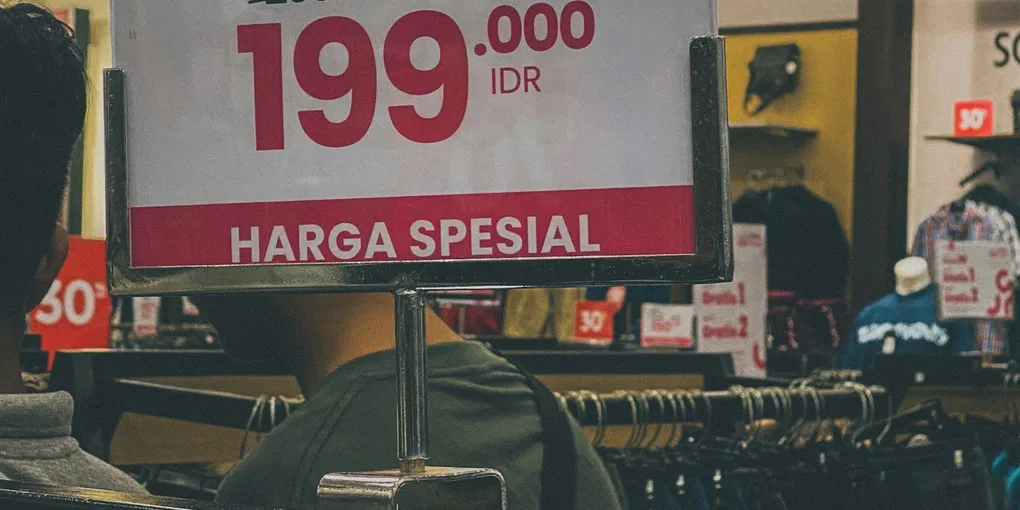
Once you recognize anchoring, you begin seeing it everywhere. Real estate listings set expectations long before an appraisal does. Salary negotiations tilt on whoever names the first figure. The struck-through original price above a sale tag is not leftover formatting, it is the entire mechanism. Research published in consumer psychology journals has even shown that the horizontal position of the two numbers matters: when the regular price sits to the left of the discounted one, matching the direction in which people read, shoppers form higher estimates of the item’s worth and perceive the product as higher quality. The first number seen wins, and everyone in commerce knows who gets to place it there.
Why So Many Prices End in Nine
Walk down any commercial street and count the prices ending in ninety-nine cents. The pattern is so universal that it fades into invisibility, which is precisely why it works. The explanation begins with a quirk of how humans read numbers. We do not process digits simultaneously; we scan them left to right, and by the time our eyes reach the final digits, the magnitude judgment is largely complete. A price of 9.99 dollars registers as nine-something, not ten-something, because the leftmost digit anchors the impression. Researchers call this the left-digit effect, and it means that a one-cent reduction can shift perception by a full unit.
Field experiments suggest the effect goes deeper than rounding. Economists Eric Anderson and Ryan Simester ran controlled trials using mail-order catalogs and found something that violates straightforward economic logic: when they raised the price of a dress from 34 dollars to 39 dollars, demand actually increased. At 44 dollars it fell. The nine ending did double duty. It lowered the perceived left digit, and it carried a cultural meaning, a signal that this item had been marked down, that a deal existed here. Prices ending in nine have been trained into consumers for generations as the uniform of the discount, so the ending itself communicates before any conscious evaluation begins.
The lesson comes with an important edge case. Luxury sellers overwhelmingly avoid charm prices, preferring round figures such as 1,200 over 1,199. The reason is the flip side of the same psychology. Round numbers read as considered and confident, appropriate for goods whose appeal rests on craftsmanship rather than bargain. A Rolex priced at 9,999 would whisper discount, and discount is poison to exclusivity. The ending of a price, then, is a tone of voice. Nine speaks the language of the deal. Zero speaks the language of quality. Businesses choose endings the way speakers choose accents, and audiences hear the accent before they hear the words.
The Option Nobody Is Meant to Choose
Some of the most elegant demonstrations of pricing psychology involve options that exist only to be ignored. Behavioral economist Dan Ariely famously walked his students through subscription tiers offered by The Economist: an online-only subscription, a print-only subscription, and a combined print and web subscription. With the actual prices presented, nearly everyone chose the combination, and almost nobody chose print alone. Then Ariely removed the print-only option, and preferences flipped dramatically toward the cheaper web-only plan. The print-only tier, which virtually no one wanted, was steering decisions anyway. It made the combined package look like an extraordinary capture of value, because the comparison had been engineered to flatter it.
Researchers call this the decoy effect, or asymmetric dominance. An option that is deliberately inferior to a target option in every respect, while remaining comparable, pushes choosers toward the target. Movie theaters size their popcorn accordingly, pricing the medium so close to the large that the large seems sensible. Software companies construct three-tier pricing pages where the middle plan is the intended destination, flanked by a stripped-down entry level and a premium level priced to legitimize it. The compromise effect reinforces the maneuver, because people tend to avoid extremes and reach for the middle, assuming it balances risk and reward.
None of this requires deception in any legal sense. Every option is real and honestly priced. What the decoy exploits is a structural feature of human judgment: we rarely evaluate things in isolation, we evaluate them against alternatives, and whoever controls the alternatives controls much of the conclusion. A shopper who believes she chose wisely from a menu has usually chosen exactly where the menu pointed. Recognizing a decoy does not mean the target option is bad; sometimes it genuinely is the best deal. It means the feeling of having discovered value may itself have been designed.
The Pain of Paying and the Art of Framing
Kahneman and Tversky’s prospect theory produced one of the most replicated findings in behavioral science: losses hurt roughly twice as much as equivalent gains feel good. This asymmetry, known as loss aversion, quietly reorganizes all of commerce, because every purchase is framed either as giving something up or as getting something. Sellers choose the frame with care. A retailer offering a discount for cash will describe it as a cash bonus rather than a credit card fee, though the economics are identical, because a penalty activates loss aversion while a bonus activates opportunity. Surveys consistently find that people judge the surcharge as unfair and the discount as generous, even when the final amounts match to the penny.
Mental accounting, a concept developed by Richard Thaler, adds another layer. People do not treat money as fully interchangeable; they sort it into buckets with different emotional weights. A tax refund, a rebate, and a paycheck of equal size feel different in the hand, and spending behaves accordingly. Businesses exploit bucket boundaries constantly. Rebates are structured so the money returns as a windfall rather than never leaving as a cost. Employers split compensation between salary and bonus, converting guaranteed money into a recurring celebration.
Perhaps the most consequential framing innovation of the past century is the decoupling of payment from consumption. Subscriptions separate the sting from the pleasure with calendar precision. A gym charges in monthly installments regardless of visits, and the industry has historically depended on members who pay without attending. All-inclusive resorts bundle every transaction into one upfront figure, after which food and drink arrive feeling free. Streaming platforms charge so little per month that the individual movie feels costless, which is the point. Each design reduces what researchers call the pain of paying, that flicker of discomfort at the moment of exchange. Cash makes the pain vivid, which is partly why people spend less with it, and digital payments make it faint, which is partly why they spend more. The medium of payment is itself a pricing decision.
Ownership Before You Buy
In a classic series of experiments, Kahneman, Jack Knetsch, and Thaler handed coffee mugs to half a room and asked buyers and owners to negotiate a trade. Owners demanded roughly twice what buyers offered. The mug had not changed; ownership had. Once something is ours, losing it registers as a loss, and losses, as established, weigh double. This endowment effect explains why free trials are among the most powerful conversion tools in modern business. After thirty days, the software is not a proposal anymore, it is a possession, populated with projects, preferences, and history. Cancelling is no longer declining an offer. Cancelling is taking something away from yourself.
The same logic scales into what might be called engineered sunk cost. Every playlist migrated, every photo uploaded, every workflow customized becomes an investment that raises the psychological exit price, independent of whether the service still represents the best available option. Time invested in learning an interface creates reluctance to abandon that effort and start over elsewhere. Savvy retention strategy does not need to manufacture loyalty from nothing, because the customer’s accumulated effort is already doing that work for free. It needs only to catch someone at the moment of genuine wavering, comparing a competitor, feeling the first flicker of dissatisfaction, and tip the balance with a well-timed offer. A discount delivered at that instant is cheap precisely because the customer’s own sunk investment supplies the gravity.
The Power of the Default
Among all the forces in this catalogue, none operates with quieter efficiency than the default. When the United Kingdom introduced automatic enrolment into workplace pensions, shifting the question from whether employees wished to join to whether they wished to leave, participation rates climbed from roughly half of eligible workers to levels above eighty-five percent. The financial logic of joining had not changed at all. The default had. Comparable patterns appear wherever researchers look: in countries where organ donation requires active consent, consent rates sometimes languish in the teens or twenties, while neighboring countries requiring active dissent report rates near ninety percent. The gap between those numbers measures not differences in generosity between populations, but the gravitational pull of whatever happens without action.
Defaults matter because deliberation is expensive and status quo bias makes inaction feel safe. Businesses build on this foundation everywhere. Pre-checked boxes add insurance and upgrades to carts. Standard plans renew automatically while cancellation lives several menus deep. Free tiers are configured so that the convenient path leads upward into paid ones. None of these arrangements forces anything, and that is the essential property of the mechanism: it merely arranges the path of least resistance, knowing that most travelers follow it.
There is an inward-facing version of the same force inside companies themselves. Resistance to new processes, new tools, and reorganizations frequently has little to do with the merits of the change and everything to do with the fact that the old arrangement is the incumbent default. Leaders who respond by arguing harder about the benefits are fighting a bias that does not respond to argument. The effective response changes the default itself, making the new process automatic and the old one optional. Status quo bias cannot be out-debated. It can only be relocated.
Scarcity, Real and Manufactured
Psychologists documented the strange power of rarity in a study involving nothing more than cookie jars. Researchers filled jars with ten cookies or two cookies and asked participants to rate them. Cookies from scarce jars were judged more desirable, and when a jar started with ten and was visibly reduced to two in front of participants, those cookies received the highest ratings of all. Demand rose not just from scarcity but from watching abundance disappear. Follow-up findings suggested that seeing others take the cookies amplified the effect further, hinting that competition sharpens desire.
Scarcity marketing industrialized that insight. Limited editions, seasonal releases, countdown timers, low-stock warnings, and waitlists all compress the window in which deliberation can occur. Underneath runs a related mechanism called psychological reactance: when a freedom appears threatened, the freedom becomes more attractive, and the urge to preserve access can overwhelm the evaluation of whether access was worth wanting. A product available forever is a consideration. The same product disappearing Sunday night is an emergency.
The honest and dishonest versions of scarcity differ in substance, not appearance. Genuine limits, whether from small-batch production, finite inventory, or true time windows, create urgency around real constraints, and luxury houses have built centuries of equity on credible restraint. Manufactured scarcity borrows the costume of constraint to hurry decisions that deserve slower ones. From the outside the two are often indistinguishable, which is exactly the problem for anyone standing at a checkout screen at midnight wondering if the timer is real.
When Persuasion Becomes Friction
Every mechanism described so far can serve value or replace it, and the boundary between the two has become the defining battleground of digital commerce. The cautionary tale reached its resolution recently, and the scale of it justifies attention. Regulators alleged that Amazon had designed its Prime cancellation process as a labyrinth, a flow of confirmation pages, benefit reminders, and detours that members had to navigate to exit a subscription they had joined in a few clicks. According to reporting on documents that surfaced during litigation, employees inside the company had flagged the design as a problem years earlier, with one describing it in striking language as an unspoken cancer, while simplification efforts stalled amid concerns about revenue. The Federal Trade Commission sued, and the matter settled in September 2025 for 2.5 billion dollars, one of the largest penalties ever obtained over website design itself.
The settlement formalizes a distinction that business psychology had already drawn. Retention built on genuine value amplifies something real: the product is worth keeping, the habit serves the user, the sunk investment reflects satisfaction. Retention built on friction substitutes obstacles for value, charging customers in frustration what the product cannot charge in quality. The first compounds trust, and trust, as the collapse of any beloved brand demonstrates, is slow to build and fast to spend. The second generates excellent quarterly metrics until regulators, competitors, or simple exhaustion arrive to collect.
Enforcement trends suggest the second path is getting more expensive. Agencies on both sides of the Atlantic have moved against dark patterns, the interface designs that trick, obstruct, or shame users into staying and paying, and payment processors and app stores increasingly impose their own rules. There is ongoing debate about where persuasion ends and manipulation begins, but the economic direction is clear enough: friction that once appeared free now carries a measurable liability, and boards are beginning to price it as such.
Reading Prices as an Investor
For investors, this entire body of psychology condenses into a single practical instrument: the ability to distinguish pricing power earned from pricing power borrowed. Warren Buffett’s longtime test of a great business is whether it can raise prices without losing customers. The test remains sound, but psychology refines it. Pricing power sustained by genuine habit, quality perception, and switching costs rooted in real value tends to persist and compound, showing up in margins that survive recessions and competitors alike. Pricing power sustained by confusion, inertia, dark patterns, and manufactured urgency shows up in the same margins, temporarily, and then evaporates the moment transparency arrives, whether through a regulator, a rival with a cleaner offer, or a viral tutorial explaining how to cancel.
The JCPenney disaster reads differently through this lens than most retrospectives allow. The conventional verdict holds that management ignored consumer psychology and destroyed value. That is true, but incomplete. What the episode proved is that psychology is not decoration applied to demand; psychology is demand. Customers derived real utility from the hunt, and a strategy that removed the utility, however honestly, removed the reason to show up. Meanwhile the opposite error, leaning too hard on the levers, produces its own reckoning, as the largest technology companies are currently discovering in courtrooms. Between those failure modes lies the narrow craft: use the architecture of human judgment to communicate real value clearly, and never to simulate value that does not exist.
Signals for separating the two are available to anyone willing to look. Companies whose retention survives the removal of cancellation obstacles tend to have the durable kind. Brands that can state prices plainly, without perpetual asterisks and phantom reference prices, are usually selling confidence rather than confusion. Rising churn immediately after a UX cleanup suggests the previous churn was manufactured. None of these signals appears in a spreadsheet automatically, which is precisely why the investor who understands behavioral economics holds information the market prices late.
The Price of Understanding
Every price tag is a small negotiation between two minds, the one that set the number and the one reading it. Only one of those minds chose the setting, the comparisons, the frame, and the defaults. That asymmetry is not a conspiracy; it is craft, refined over a century of retail experimentation and validated by decades of laboratory science. But asymmetries favor whoever understands them, and understanding is available on both sides of the counter.
The literate consumer neither surrenders to every nudge nor grows cynical about commerce itself. Awareness simply restores the missing step between stimulus and purchase: noticing the anchor before adopting it, asking what the decoy is steering toward, feeling the timer’s urgency and letting it pass, deciding deliberately whether the default serves you or merely its designer. Businesses face the mirrored discipline. The psychology of pricing is neither good nor evil, it is leverage, and leverage reveals character. Applied to genuine value it builds patient fortunes, the kind that survive scrutiny and compound quietly for decades. Applied to illusion it builds the other kind, impressive until the moment the lights come on and the audience sees the stage.
Markets ultimately reward honesty with durability, though rarely on the schedule anyone prefers. Prices will always be stories told in numbers, and the tellers will always hold the pen. The enduring advantage belongs to those who know how the story is written, whether they are telling it, or hearing it told to them.